

Creating your own Rust cheats is technically possible, but it requires advanced programming knowledge, reverse engineering skills, and a deep understanding of anti-cheat systems. This comprehensive guide explores whether making your own Rust cheats is realistic, what skills you need, and whether it is worth the effort.
The Short Answer
Yes, you can make your own Rust cheats - but it is extremely difficult and time-consuming. Unless you are an experienced programmer with knowledge of C++, assembly, Windows internals, and reverse engineering, compare the effort with buying Rust software from an established provider or reviewing the available Rust products.
Most people who ask this question underestimate the complexity involved. Creating and maintaining a working Rust project can take months or longer, and every game update can create more work. Compare that commitment with the process described in the Rust product and setup guide.
What You Need to Know
Programming Skills Required
To create Rust cheats, you need expertise in:
- C++ or C - Most game cheats are written in C++ for performance and low-level access
- Assembly language - For understanding game memory and bypassing protections
- Windows API - For process manipulation and memory reading
- Systems programming - Low-level Windows concepts, drivers, memory, and process boundaries require specialist knowledge
- Reverse engineering - To understand how Rust stores player data, positions, and game state
Tools You Will Need
- Debugger - x64dbg, WinDbg, or IDA Pro for analyzing game code
- Memory scanner - Cheat Engine for finding memory addresses
- Disassembler - IDA Pro or Ghidra for reverse engineering
- Compiler - Visual Studio for building your cheat
- Kernel driver development kit - For creating kernel-level components
Understanding EasyAntiCheat
EasyAntiCheat (EAC) is one of the most sophisticated anti-cheat systems. To bypass it, you need to understand:
- Signature scanning - How EAC detects known cheat patterns
- Memory integrity checks - How EAC verifies game memory is not modified
- Kernel callbacks - How EAC monitors system activity
- Screenshot detection - How EAC can capture your screen
- Behavior analysis - How EAC flags suspicious player actions
Reality Check: Most professional cheat developers have 5-10 years of programming experience and still spend months developing and maintaining their cheats.
The Development Process
Step 1: Learn the Basics
Before attempting Rust cheats, you should:
- Master C++ programming - Understand pointers, memory management, and object-oriented programming
- Learn Windows internals - Study how Windows manages processes and memory
- Practice with simpler games - Start with single-player games without anti-cheat
- Study existing open-source cheats - Analyze code from GitHub (but never use public cheats in Rust)
Step 2: Reverse Engineer Rust
You need to find memory addresses for:
- Player positions - X, Y, Z coordinates of all players
- Player health - Current health values
- Player names - To identify players
- Item locations - Positions of loot and resources
- Game state - Current game mode, server info, etc.
This process involves:
- Attaching a debugger to Rust
- Scanning memory for known values (your health, position, etc.)
- Finding patterns that remain consistent across game updates
- Creating offsets and signatures for reliable access
Warning: Reverse engineering Rust violates the Terms of Service and can result in permanent bans. Only do this on offline test environments or separate hardware.
Step 3: Develop Core Features
Start with basic features:
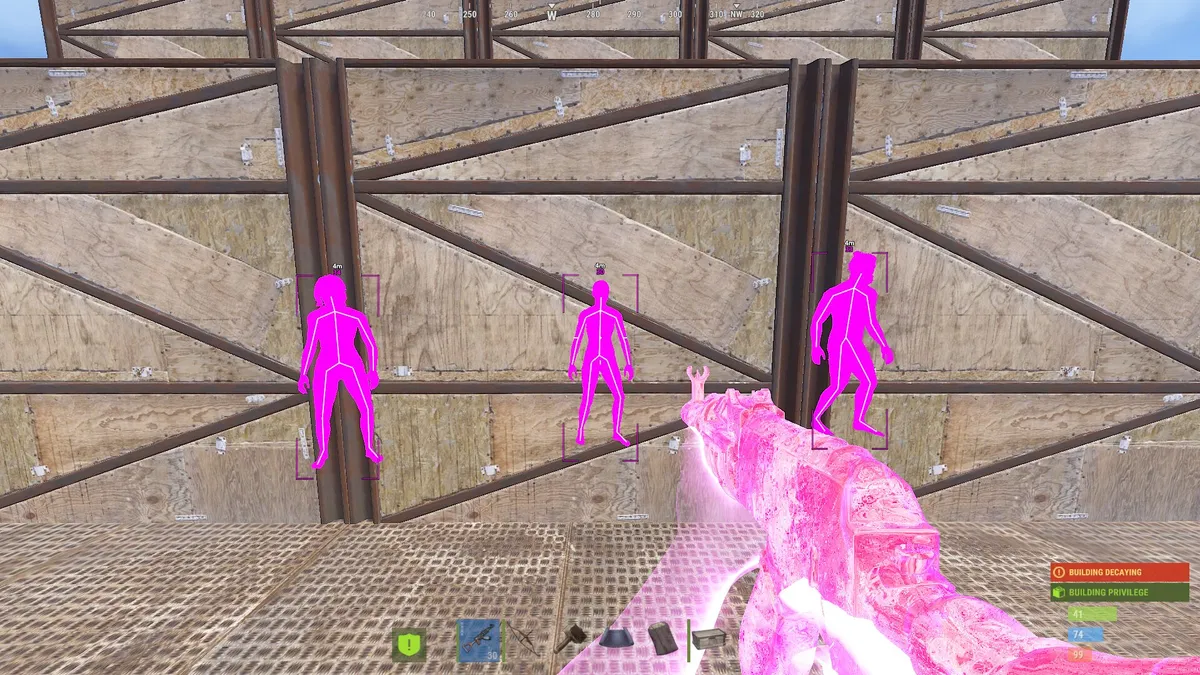
- ESP (Wallhack) - Drawing player positions on screen
- Aimbot - Automatically aiming at enemies
- No recoil - Removing weapon recoil
Each feature requires:
- Reading game memory safely
- Processing the data
- Rendering overlays or modifying game behavior
- Avoiding detection by EAC
Step 4: Bypass EasyAntiCheat
This is the hardest part. You need to:
- Operate at kernel level - Create a kernel driver to avoid user-mode detection
- Obfuscate your code - Make your cheat unrecognizable to signature scans
- Avoid known patterns - Do not use common cheat techniques that EAC knows about
- Test extensively - Verify your cheat does not trigger any EAC flags
Important: Bypassing EAC requires kernel-level programming, which can cause system instability or even brick your PC if done incorrectly.
Step 5: Maintain and Update
Game updates break cheats constantly. You will need to:
- Update memory offsets after every Rust patch
- Adapt to new EAC detection methods
- Fix bugs and crashes
- Test on throwaway accounts
Time and Effort Required
Learning Phase
The learning phase depends on your existing knowledge of C++, Windows internals, debugging, and reverse engineering. An experienced systems programmer starts from a very different position than a complete beginner, so a fixed month estimate is misleading.
Development Phase
An initial prototype is only the beginning. Compatibility testing, error handling, game updates, support, and maintenance continue for as long as the software is used.
Total Time Investment
Expect a substantial long-term commitment across learning, development, testing, and maintenance rather than a one-time build.
Costs Involved
Even if you do it yourself, there are costs:
- Development tools - Commercial debugging and reverse-engineering tools can require paid licenses
- Testing environments - Isolated systems and disposable test environments add cost
- Hardware - Separate test hardware may be needed for safe research
- Learning resources - Courses, books, tutorials
The total cost varies substantially with the tools, hardware, and learning resources selected. Check current vendor pricing before budgeting because fixed figures become outdated quickly.
Alternatives to Making Your Own
Use Private Cheats
For most players, buying Rust cheats from established providers is the more practical choice — for example Disconnect Rust External for external operation or Disconnect Rust Internal for deeper features. Before deciding, review what makes the best Rust cheats and the current Rust cheat pricing guide.
Pros:
- Works immediately
- Regular updates
- Support available
- Avoids the tooling and research cost of developing your own
- Maintained product instructions and status reporting
Cons:
- Monthly subscription cost
- Dependent on provider
- Less customization
Cost: Refer to the current product pages because plans and prices can change.
Once you've decided to buy instead of build, learn how to install Rust cheats safely and how to look legit with Rust cheats to minimize ban risk.
Hire a Developer
If you want custom features, hire an experienced cheat developer.
Pros:
- Custom features for your needs
- Professional quality
- No learning curve
Cons:
- Pricing is highly variable and requires a clearly defined scope
- Need to find trustworthy developer
- Still requires maintenance
Is It Worth It?
When It Makes Sense
Making your own Rust cheat is worth it if:
- You are already an experienced programmer
- You want to learn reverse engineering and game hacking
- You plan to sell or distribute your cheat
- You enjoy the challenge and learning process
- You have months of free time to dedicate
When It Does Not Make Sense
Skip making your own cheat if:
- You just want to play Rust with advantages
- You have no programming experience
- You do not have time for months of development
- You want something that works now
- You cannot afford to lose test accounts
Recommendation: For 99% of players, using an existing private cheat is the better choice. The time and effort required to make your own is simply not worth it unless you are genuinely interested in the technical challenge.
Legal and Ethical Considerations
Legal Risks
The legal position depends on the jurisdiction, conduct, contracts, and distribution model. Relevant risks can include:
- Violates Rust Terms of Service
- Can result in permanent bans
- May violate anti-circumvention laws in some countries
- Selling cheats can lead to legal action from game developers
Ethical Considerations
Consider the impact:
- Ruins gameplay experience for legitimate players
- Damages the Rust community
- Gives you unfair advantages
- Can lead to server instability
Learning Resources
If you still want to learn, here are legitimate educational resources:
Programming Fundamentals
- Learn C++ - Codecademy, Udemy courses
- Windows API - Microsoft documentation
- Memory management - Books like "Windows Internals"
Game Hacking Basics
- Guided Hacking forum - Educational community for game hacking
- UnknownCheats forum - Advanced discussions and tutorials
- YouTube tutorials - Search for "game hacking tutorial" (educational only)
Reverse Engineering
- IDA Pro tutorials - Learn to use disassemblers
- Cheat Engine tutorials - Practice finding memory addresses
- Assembly language - Understanding low-level code
Disclaimer: These resources are for educational purposes only. Using this knowledge to cheat in online games violates Terms of Service and can result in bans.
Frequently Asked Questions
Can I learn to make Rust cheats with no programming experience?
Technically yes, but the timeline depends heavily on your starting knowledge and available study time. You need a strong foundation in C++, Windows programming, debugging, and reverse engineering before attempting a complex project.
Are there tutorials for making Rust cheats?
There are general game hacking tutorials, but specific Rust cheat tutorials are rare and often outdated. Most developers keep their methods private to avoid detection.
Can I use open-source Rust cheats from GitHub?
Public repositories can be useful for studying general programming concepts, but they may be outdated, modified, unsafe, or already known to anti-cheat systems. Never run unverified code on a production system or game account.
How do professional developers maintain private software?
They maintain controlled build and distribution processes, test changes, monitor compatibility, and update the software as the game environment changes. None of those practices can guarantee permanent status.
Is it illegal to make game cheats?
The legal position depends on the jurisdiction, distribution method and conduct involved, while use can also violate game and platform terms. Seek qualified legal advice for a specific situation.
Can selling Rust cheats generate income?
Revenue varies widely and public estimates are difficult to verify. Distribution also creates support, payment, contractual, platform, and legal risks, so projected earnings should not be treated as reliable.
Conclusion
Making your own Rust cheats is an enormous undertaking that requires advanced programming skills, months of development time, and ongoing maintenance. For most players, it is simply not worth the effort.
If you want to cheat in Rust:
- Compare current Rust cheat options
- Faster to evaluate than building and maintaining software from scratch
- Professional support and updates included
- Learn how to get started with Rust cheats
If you want to learn game hacking:
- Start with simpler games without anti-cheat
- Learn C++, reverse engineering, and Windows internals
- Join educational communities like Guided Hacking
- Practice on single-player games first
If you are determined to make your own:
- Plan for a substantial learning and development commitment
- Budget for current tooling, isolated testing, and ongoing maintenance
- Be prepared for constant updates and maintenance
- Use isolated, authorized test environments and expect repeated failures during development
The choice is yours, but now you understand what is really involved in creating Rust cheats.